
Beyond Compliance: The Financial Risk Inside the Deal

Dealer principal is chasing the dollar bill that is running away

When dealers think about compliance risk, they often think about regulatory enforcement: an investigation, a penalty or a public lawsuit.

But some of the most consequential dealership losses never involve a regulator.

Lender recourse demands, contract repurchases, consumer disputes, fraud-related losses, and private settlements can create significant financial exposure without ever becoming public.

A lender may question a contract after discovering identity concerns, material application discrepancies, or suspected fraud. A consumer may challenge what was disclosed about a vehicle’s history, prior use, condition, price, or other material information. The matter may be resolved directly with the lender or consumer, through counsel, or through a voluntary repurchase.

There may be no regulatory action or public record of the loss.


The Exposure Is Difficult to Measure Because Much of It Is Private

There is no comprehensive public dataset establishing the average amount a U.S. dealership loses each year to lender buybacks, recourse demands, or fraud-related contract repurchases. Consumer buybacks, rescissions, settlements, and other private disputes are even more difficult to quantify.


That makes this category of dealership risk easy to underestimate.


A dealership can face financial exposure even when it did not intentionally cause the underlying problem. A customer may misrepresent income or employment. A fraudulent applicant may use a stolen or synthetic identity. A required process may not be completed. A disclosure may have been made but not documented well enough to establish what occurred.

The issue is not always misconduct.

Sometimes, the problem is what the dealership can establish after the transaction is challenged.


A Modeled View of the Exposure

Point Predictive reported approximately $10.4 billion in auto-lending fraud and misrepresentation exposure for 2025. Using that figure and its reported fraud categories as a starting point, TDC developed an illustrative model to examine how a portion of that exposure could translate into dealer-side recourse and buyback risk.


The model uses reported auto-lending fraud exposure and fraud categories, together with disclosed assumptions regarding early-stage fraud-related performance problems, potential dealer pass-through, and dealership population.

TDC Illustrative Model

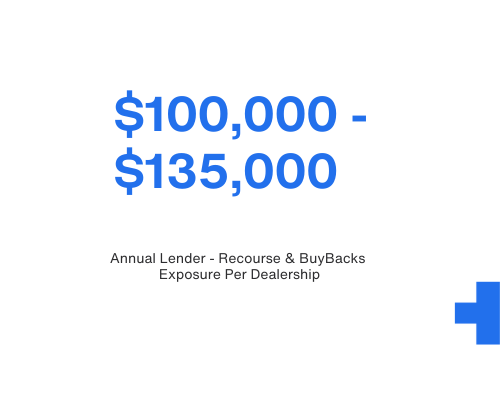
$100,000–$135,000 In Potential Annual Lender-Recourse and Buyback Exposure Per Dealership

The modeled exposure includes income and employment misrepresentation, straw-purchase activity and true-name identity theft.

This is an illustrative scenario analysis. Actual exposure may be materially higher or lower depending on lender agreements, recourse provisions, deal volume, customer profile, fraud controls, financing sources, verification procedures, and the facts of individual transactions.

The assumptions, calculations, sources, and limitations of the model are disclosed in the full paper.
$110k annual exposure per dealership
What Dealership Leaders Told Us

TDC also conducted an informal survey of 70 dealership general managers and dealer principals to better understand their experience with buybacks.

Approximately 40% of respondents reported that their dealership had experienced at least one buyback during the preceding year.

Among respondents reporting a buyback, approximately 75% believed the event could likely have been prevented if an existing dealership policy or procedure had been followed consistently.

The survey was informal and was not designed to be statistically representative of the U.S. dealership population. The results should not be interpreted as national buyback rates, average buyback frequency, or average financial loss.

But they point to an important operational issue: the dealership may already have the right policy. The problem is whether that policy is consistently carried through the individual transaction—and whether the dealership can later establish that it was followed.


A Deal Can Look Complete Until It Is Questioned

At delivery, a transaction may appear complete. The customer has signed. The lender has funded the loan. The vehicle was registered.

The evidence problem often appears later.

Consider a customer who defaults on a loan, prompting the lender to review the loan origination. The credit application submitted to the lender shows monthly income of $12,000. But when the lender contacts the customer to verify the information, the customer denies ever providing that figure.

If the dealership has only the final application, it can show what was submitted—but not necessarily where the income figure originated, what changed, who made the change, or whether the customer reviewed and confirmed the corrected information.

Simply retaining an original and final application may not solve the problem either. Two applications containing materially different information, without a clear record explaining the change, can leave the same questions unanswered.

Vehicle history provides another example.

A CARFAX or AutoCheck report in the deal jacket establishes that the dealership obtained and retained the report. It does not necessarily establish that the customer received, reviewed, or acknowledged it.

If the customer later disputes prior accident history, damage, rental use, fleet use, or another material fact, that distinction can matter.

The problem is not always what actually happened. It is what the transaction record can establish happened.


Can Your Deal Jacket Tell The Story of the Transaction?

Untitled design (57)


Transaction disputes may arise weeks, months, or years after delivery. By then, employees may have left, recollections from consumers and dealership staff may differ.

A complete deal jacket contains documents. A defensible transaction record establishes how the deal happened.

Can Your Transaction Record Answer These Questions?

  • What did the customer originally provide?

  • What information changed?

  • Who made the change?

  • When did it occur?

  • What did the customer see and acknowledge?

  • What verification steps were completed?

  • Where is the evidence?

Most transactions will never be challenged. The record becomes particularly important for the ones that are.

Vector Right

Go Deeper: Beyond Regulatory Compliance

Defensible transaction technology


Beyond Regulatory Compliance: Why Dealerships Need a Defensible Transaction Record examines the financial exposure that can arise outside regulatory enforcement and what happens when an individual transaction is later challenged.

The full paper includes the complete illustrative exposure model and methodology, findings from TDC’s informal survey of 70 dealership leaders, examples of common transaction-evidence gaps, and a practical framework for strengthening the record created during the transaction.

This material is provided for general educational and informational purposes only and is not legal advice. The financial model is an illustrative scenario analysis and should not be interpreted as a measurement or prediction of actual dealership losses. 

Vector Right