

Auto Dealership Compliance. Enforced.

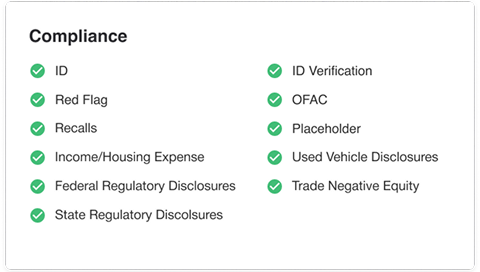
Auto dealership compliance today must extend far beyond basic regulatory requirements. Most dealerships already have additional policies, protections, and forms in place—but the execution is still manual, paper-driven, and inconsistently followed.

TDC unifies all of this into one enforced digital workflow that captures every step, generates irrefutable proof, and protects the dealership from preventable recourse, buy-backs, and audit exposure.

Auto Dealership Compliance dashboard
Vector

Dealership Compliance With TDC vs. Without TDC

Area
Without TDC
Risk Coverage
Regulatory-only; major financial risks left unprotected.
Regulatory + non-regulatory risk enforcement
Red Flags Clearing
Skipped quizzes; inconsistent clearing; manual steps to store evidence
Required quizzes; evidence auto-generated and logged
Regulatory Disclosures
Must print, sign, copy, and file manually
Auto-generated; delivered to customer's Glove Box
Recalls (Used & Trades)
Manual lookup → print → signature → file
Auto-run recalls; digital signature; proof stored
State & Dealer-Specific Documents
Staff manually selects, prints, signs twice
Forms staged automatically based on deal data
Vehicle History Reports (Used & Trade)
Manual lookup → print → signature → file
Auto-run; staged for signature; logged
NPI Security
Customer's NPI stored on personal phones, unlocked drawers, shared folders
No printed NPI; secure sharing environment
Vector Right
  • Automotive Regulatory Compliance
  • Financial Protection
  • Data Security

Red Flags Clearing & Identity Verification

Why do Red Flags clearing steps get skipped?

Red Flags checks often run automatically, but they do not always clear automatically. Clearing a Red Flags alert typically requires additional manual steps—such as completing an identity verification (IDV) quiz and printing and filing the supporting documentation—which are frequently overlooked. If these steps are skipped, the dealership may lack the documentation needed to defend the identity verification process if it is later challenged.

How does TDC handle Red Flags clearing?

Runs Red Flags checks instantly and, when additional identity verification is required, enforces completion of the IDV quiz before the deal can proceed. Optional driver's license verification provides an added layer of identity validation, and all supporting documentation is automatically stored in the digital deal jacket for a complete audit trail.

Result

Every flagged identity is properly cleared with documented proof.

Federal & State Disclosures & Dealer Policies

What makes disclosure delivery difficult for dealerships?

Regulatory disclosures require dealerships to identify the correct forms, obtain signatures, deliver customer copies, and retain proof of compliance. Because these steps are performed manually, forms are frequently missed, incorrect, or filed without adequate documentation, creating audit risk.

How does TDC automate federal and state disclosures?

TDC automates the entire disclosure process. Required disclosures are automatically identified and delivered to the customer, while forms requiring customer signatures are automatically identified, staged for digital signing, and documented in the deal jacket.

Why are recall and vehicle history checks frequently incomplete?

Recall and vehicle history checks often rely on dealership staff to manually run reports, print the results, obtain customer acknowledgments, and file the documentation. These manual steps are frequently skipped, exposing the dealership to customer disputes and potential buyback claims.

How does TDC automate recall and vehicle history checks?

TDC automatically runs recall checks and vehicle history reports for purchased vehicles and trade-ins, presents the results to the customer, captures digital acknowledgment, and stores all documentation in the digital deal jacket. The result is a complete, auditable record of every required vehicle disclosure.

Result

Automotive regulatory compliance requirements are met on every deal with documented proof. Every deal gets the right forms with complete signatures and documented delivery.

Buy-Back Defense

What is the financial exposure from fraud and misrepresentation?

In 2024, auto lenders reported $9.2B in fraud and misrepresentation (Point Predictive). While these are lender-side losses, they can—and routinely do—shift a share of fraud and early‑default losses back to dealers through recourse provisions and loan buy‑back demands (approximately 20%). This means that averaged out across all dealers in the US,each dealership carries the estimated risk exposure of about $100,000–$130,000 per store, per year.

Why does liability shift matter for dealerships?

While lenders reasonably expect due diligence, verification is not always possible. Yet when discrepancies surface, the dealership is the party held financially responsible—even when the customer is the one who misrepresented the data.

How does TDC create a liability shift?

TDC creates a customer-authenticated record of every credit application. Customers enter their information directly through a secure, authenticated portal with identity verification, while timestamps, device information, and submission history are automatically recorded. If dealership staff modifies key information—such as income, employment, or housing details—TDC flags the change and requires the customer to review and confirm it before the deal can proceed. All signatures and acknowledgments are completed by the authenticated customer, providing a verifiable audit trail and helping protect the dealership from disputes.

Result

Documentation that shifts liability away from the dealer—and provides the proof required during lender investigations or recourse disputes.

Deal Jacket Completion & Real-Time Status Visibility

Why do dealerships struggle with incomplete deal jackets?

Upper management only discovers missing compliance documentation during disputes—when it's too late to fix. This discovery requires a manual review of the whole deal. Leadership has no visibility into which deals are closed with gaps.

How does TDC ensure deal jacket completion?

TDC prevents deals from reaching Delivered status until every required compliance step has been completed. A real-time dashboard shows staff exactly what's missing, while any overridden requirements are automatically logged and included in daily management reports for full accountability. TDC also cross-references your DMS to automatically identify and flag deals processed outside the platform, helping ensure compliance policies are consistently followed across every transaction.

Result

Every "Delivered" deal on TDC is audit-ready. No gaps. No surprises. Enforced

Secure Customer Document Collection

Why is collecting customer documents a security risk?

Sensitive customer documents are often collected through email, text messages, paper, or personal devices, creating unnecessary exposure of non-public personal information (NPI). These manual processes increase the risk of data breaches and make FTC Safeguards Rule compliance more difficult.

How does TDC secure document collection?

Customers upload documents directly through a secure, authenticated portal, creating a verifiable record of submission while eliminating email, text messages, printed documents, and unnecessary staff handling. Documents are securely transferred and stored without exposing NPI through insecure channels.

Result

Customer NPI is securely collected through an authenticated process with significantly reduced exposure.

Secure NPI Storing

Why is storing customer documents a security risk?

Customer documents often accumulate across employee computers, downloads, email inboxes, shared folders, and other disconnected systems, making it difficult to control access to non-public personal information (NPI). As sensitive data spreads across multiple employee devices, the risk of unauthorized access, data breaches, and FTC Safeguards Rule violations increases.

How does TDC protect stored customer documents?

TDC centralizes all customer documents in a secure digital deal jacket, eliminating the need to store sensitive customer information on employee devices or in disconnected systems. Role-based access controls and a complete audit trail ensure only authorized users can access customer NPI while supporting FTC Safeguards Rule compliance.

Result

Customer NPI is protected in a single, secure system—not scattered across employee devices.

Vector

The Result: A Unified Auto Dealership Compliance System

TDC connects every required compliance step into one enforced workflow:
Customer-authenticated data
Creates the defendable foundation—timestamps, device data, and customer confirmation of any staff revisions eliminate the "he said, she said" in fraud disputes.
Real-time completion tracking
Ensures every deal that reaches "Delivered" status has passed all required checkpoints. Override tracking provides leadership visibility into any bypassed requirements.
Automated regulatory processes
Red Flags clearing, federal and state disclosures, recall checks, and vehicle history reports—run without staff intervention, generate required proofs automatically, and block incomplete deals from proceeding.
Secure NPI handling
Eliminates printed customer documents and staff device sharing, closing the exposure points that create Safeguards Rule violations.
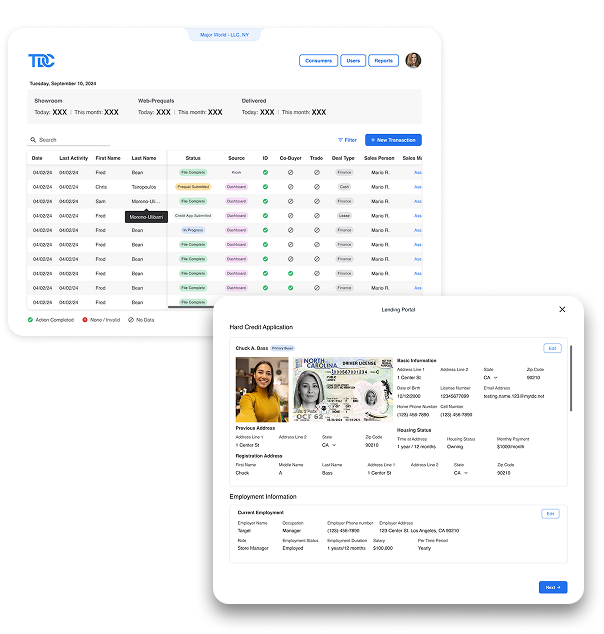
Auto dealership compliance dealership dashboard

Every step captured. Every proof generated. Every deal defensible.

TDC gives dealerships a unified, enforced auto dealership compliance system that eliminates manual steps, captures proof, and protects every deal from preventable risk.

Vector Right

See How TDC Handles Your Compliance

Vector
